By Hub Virtual Assist
You’ve got a website, invested in online marketing services, have been doing “SEO stuff”, but the phone isn’t ringing the way you expected, and your competitors keep showing up above you on Google.
A broken local SEO strategy doesn’t always announce itself loudly. More often, it quietly bleeds leads while you keep investing in a plan that isn’t producing. The good news: most local SEO problems are fixable once you know what to look for.
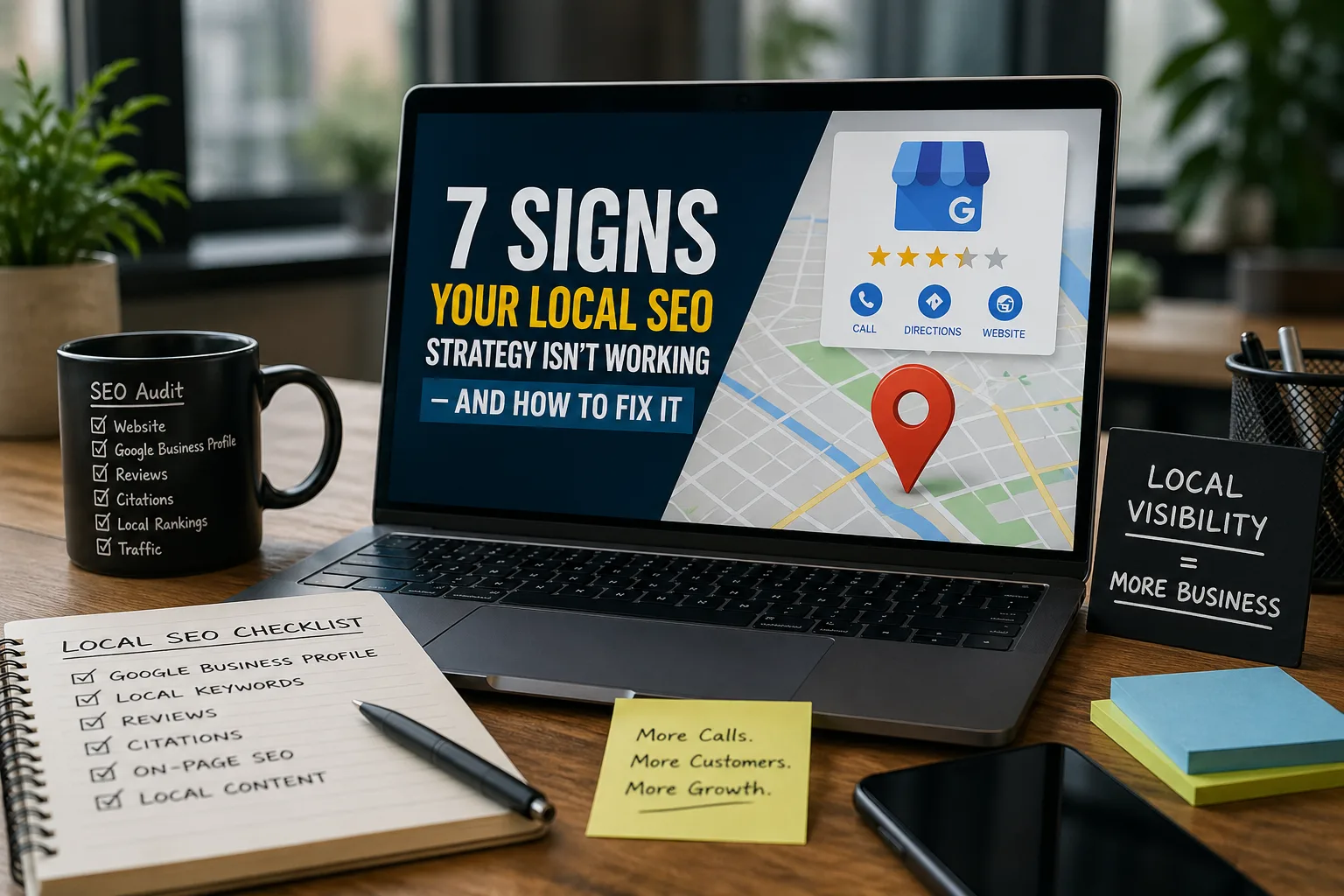
Here are seven clear signs your local SEO strategy isn’t working — and exactly what to do about each one.
Sign #1: Your Google Business Profile Has Low Visibility or Engagement
Your Google Business Profile (GBP) is the single most important local SEO asset you own. If it’s incomplete, outdated, or ignored, Google has almost no reason to show you in local search results.
Common GBP problems include missing business categories, no photos, an incomplete service description, zero recent posts, and a phone number that doesn’t match your website. Each gap chips away at your local search ranking signals.
Beyond visibility, low engagement is a red flag in itself. If your GBP gets impressions but no calls, no direction requests, and no website clicks, Google interprets that as a sign your listing isn’t relevant or trustworthy.
The fix: Audit your GBP today. Confirm your NAP (Name, Address, Phone) is exact and matches every other directory listing. Select your primary and secondary categories carefully — they drive which searches you appear in. Add at least 10 photos, write a keyword-rich business description, and publish at least one post per week. Reply to every review within 48 hours. Consistent engagement signals an active, trustworthy business to Google.
Not sure where to start? The team at Hub Virtual Assist offers GBP management services built specifically for local service businesses. Call us at (601) 281-8482 or visit hubvirtual.net to learn more.
Sign #2: You’re Not Ranking in the Local 3-Pack
The Local 3-Pack — the three businesses Google highlights at the top of local results alongside a map — captures the majority of local search clicks. If you’re not in it, you’re largely invisible to buyers who are ready to hire right now.
Google Maps ranking issues usually come down to three things: weak GBP signals, inconsistent citations across the web, and poor keyword targeting on your website. It’s rarely just one of them — it’s typically all three working against you at once.
The fix: Start with your GBP (see Sign #1). Next, audit your citations — your business name, address, and phone number must be consistent across directories like Yelp, Angi, BBB, and industry-specific sites. Use a tool like BrightLocal or Whitespark to find and correct inconsistencies. Then review your website: do your homepage and service pages include your target city and service in the headings and body copy? If not, local keyword gaps are costing you map pack placements.
Hub Virtual Assist builds and manages local SEO strategies — including full citation audits — for service businesses across the country. Reach us at admin@hubvirtual.net or (601) 281-8482.
Sign #3: Little to No Organic Traffic from Local Keywords
Log into Google Search Console and filter your traffic by queries. Are you seeing impressions and clicks from terms like “[service] in [city]” or “[service] near me”? If those queries are absent or showing near-zero traffic, your site has a local keyword gap.
This usually means your pages aren’t optimized for the specific terms your market is searching. A homepage that only says “we provide quality services” tells Google nothing about where you operate or what you do in specific terms. Google can’t rank what it can’t understand.
The fix: Build dedicated service pages for each core offering, each targeting a specific city or service area. Each page should include your primary keyword in the H1, the opening paragraph, at least one H2, and the meta title. Add locally relevant content — reference specific neighborhoods, address local conditions, and answer questions your customers actually ask. Over time, these pages compound into serious organic traffic.
Hub Virtual Assist’s SEO content writing service handles exactly this — research, writing, and on-page optimization for local service businesses. Visit hubvirtual.net or email admin@hubvirtual.net to get started.
Sign #4: Your Reviews Are Stagnant — or Mostly Negative
Google uses review quantity, recency, and sentiment as local ranking signals. A business sitting at 12 reviews from two years ago is being outpaced by a competitor with 80 reviews from the past six months — even if yours are all five stars.
Stagnant reviews tell Google your business may be inactive. Negative reviews left without responses tell potential customers you don’t care. Either way, your local search visibility and conversion rate take a hit.
The fix: Create a simple, repeatable review request process. After every completed job, text or email the customer a direct link to your GBP review page. Most satisfied customers will leave a review if you make it a one-tap process. Respond to every review — positive ones with genuine appreciation, negative ones with calm professionalism and an offer to resolve the issue offline. Aim for at least two to three new reviews per month at minimum.
If managing your GBP and reputation feels like one more thing on an already full plate, Hub Virtual Assist’s GBP management service takes it off your hands entirely. Call (601) 281-8482 to find out what’s included.
Sign #5: Your Website Has No Local Landing Pages
One homepage trying to serve your entire metro area is a local SEO dead end. Search engines want to serve hyper-relevant results, and a generic homepage doesn’t signal that you specifically serve Naperville, IL or Baton Rouge, LA the way a dedicated city page does.
If your site doesn’t have individual pages for each major city or neighborhood you serve, you’re leaving local search ranking opportunities on the table every single day.
The fix: Build location-specific service pages for each area you want to rank in. These pages can’t just be duplicates with the city name swapped — they need genuinely localized content: local context, service variations relevant to that market, and locally earned trust signals. A well-built location page is a 24/7 lead magnet that keeps working long after you publish it.
Hub Virtual Assist specializes in website builds and SEO strategies for local service businesses. If your site is missing location pages, we can build them. Visit hubvirtual.net or email admin@hubvirtual.net.
Sign #6: You Have No Backlinks from Local Sources
Backlinks from other websites still matter — a lot. For local SEO specifically, links from locally relevant sources (local news outlets, chambers of commerce, local business directories, industry associations in your area) carry disproportionate weight.
If your backlink profile is empty or filled only with generic directory submissions, Google has little reason to consider you an authority in your local market.
The fix: Start with the low-hanging fruit — get listed in your local chamber of commerce, the Better Business Bureau, and any industry-specific directories. Sponsor a local event or charity and earn a link from their site. Reach out to local bloggers or news outlets when you have something genuinely newsworthy to share. Even one or two high-quality local links per quarter can shift your rankings meaningfully over time.
Hub Virtual Assist offers link building services designed for local businesses. We handle outreach, placement, and reporting so you can focus on running your business. Talk to our link-building team — call (601) 281-8482 or visit hubvirtual.net.
Sign #7: You’re Tracking the Wrong Metrics — or None at All
If you can’t tell where your local SEO strategy stands right now, you can’t fix it. Many small business owners check overall website traffic or glance at keyword rankings — but miss the metrics that actually tell you whether local SEO is working.
What matters for local: GBP calls, direction requests, website clicks from your profile, local keyword impressions in Search Console, and — most importantly — leads that originated from local search.
The fix: Set up Google Search Console and connect it to Google Analytics. Track GBP performance directly in your Google Business Profile dashboard — it shows search queries, clicks, calls, and direction requests month over month. Consider call tracking software to tie phone leads back to specific pages and keywords. You should know, at minimum, how many calls per month are coming from local search. If you don’t, you can’t manage what you’re not measuring.
Hub Virtual Assist provides ongoing SEO strategy and reporting so you always know exactly how your local presence is performing. Call (601) 281-8482 or email admin@hubvirtual.net to discuss what tracking looks like for your business.
Your Local SEO Audit Checklist

Ready to fix your local SEO strategy? Hub Virtual Assist audits your entire local search presence — GBP, citations, content, backlinks — and tells you exactly what to prioritize.
Perform a Local SEO Audit Today
Email: admin@hubvirtual.net | Web: hubvirtual.net | Contact Our Local SEO Experts
Hub Virtual Assist — 6001-21 Argyle Forest Blvd. #352, Jacksonville, FL 32244
Frequently Asked Questions
What’s the single most important local SEO fix I can make?
Start with your Google Business Profile. It’s the highest-leverage local SEO asset you own and the fastest to improve. A complete, active, well-reviewed GBP can move the needle on local rankings within weeks — faster than almost any other single change. Hub Virtual Assist’s GBP management service handles this for you end to end.
How long before I see improvements in my local rankings?
GBP and citation fixes can show results in four to eight weeks. Content and backlink work typically takes three to six months to produce measurable ranking changes. Local SEO is a compounding strategy — results build over time, but the sooner you start, the sooner they arrive.
Is paid advertising a better option than fixing my local SEO?
Paid ads generate immediate traffic, but stop the moment you stop paying. Local SEO builds a ranking presence that continues generating leads without ongoing ad spend. Most businesses benefit from both, but organic local rankings typically deliver a better cost-per-lead over time.
Do I need an agency to fix my local SEO, or can I do it myself?
Many foundational fixes — GBP optimization, citation cleanup, review requests — can be done in-house with the right guidance. Where agencies add the most value is in content strategy, technical SEO, and link building. If you’d rather have experts handle it, Hub Virtual Assist offers full-service local SEO packages. Reach us at (601) 281-8482 or hubvirtual.net.
How often should I update my Google Business Profile?
Post to your GBP at least once per week. Update your hours any time they change, especially around holidays. Add new photos monthly. Respond to new reviews within 48 hours. Active profiles consistently outperform dormant ones — Google rewards recency and engagement.
What tools should I use to audit my local SEO?
Google Search Console and Google Analytics are essential and free. For citation auditing, BrightLocal and Whitespark are the industry standards. For keyword research, Google Keyword Planner or Semrush can surface local search volume data. If you’d rather skip the tools and get a professional assessment, Hub Virtual Assist offers local SEO audits — email admin@hubvirtual.net to request one.
Why does my competitor outrank me even though my business is older and more established?
Age and experience don’t translate directly into rankings. Google ranks based on relevance, proximity, and prominence — meaning reviews, GBP signals, and links. A newer competitor with a fully optimized GBP, consistent citations, and an active review strategy will consistently outrank an established but unoptimized business. That’s a fixable problem.