By Hub Virtual Assist
Every month, local business owners pour money into ads, social posts, and website updates — then wonder why they’re still invisible in Google’s local pack. More often than not, the culprit isn’t the website. It’s the citation network underneath it.
Citation networks are one of the most misunderstood parts of local SEO. Get them right, and they quietly reinforce your credibility across the entire web. Get them wrong — or ignore them — and even a great website loses ground to competitors who simply have cleaner data online.
Here are five things every local business needs to know about citation networks in 2026.
1. What Citation Networks Are & How They Work
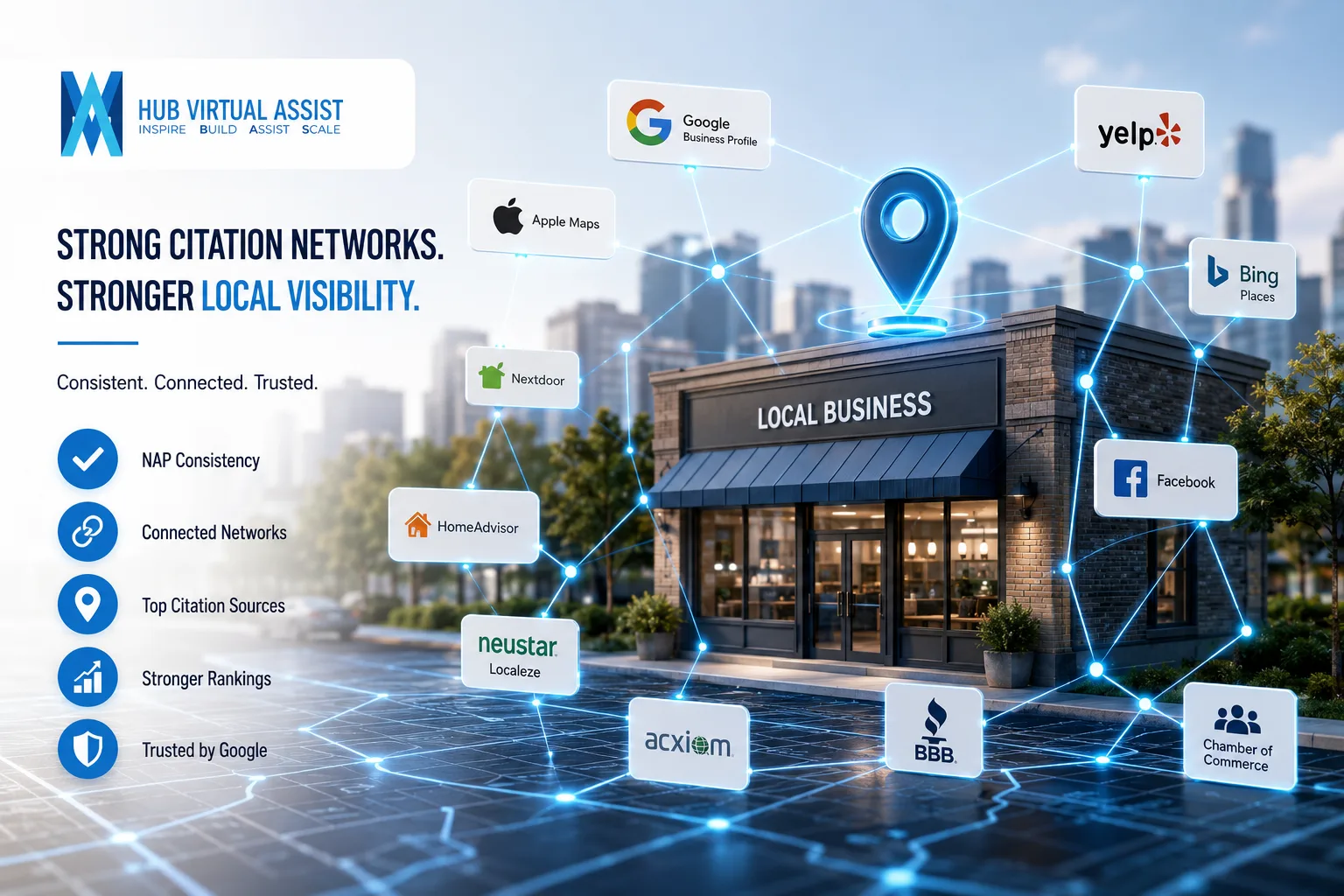
A citation is any online mention of your business that includes your Name, Address, and Phone number (NAP). A citation network is the full web of platforms, directories, and websites where those mentions live — and how they all connect back to your business entity in Google’s eyes.
There are two types:
Structured citations appear in formal directory fields. Think Google Business Profile, Yelp, Bing Places, Apple Maps, and niche platforms like HomeAdvisor or Houzz. These have designated fields for business name, address, phone, hours, and website. They’re predictable, crawlable, and carry strong trust signals.
Unstructured citations are mentions embedded in content — a local news article that references your roofing company, a community forum post, a Chamber of Commerce blog, or a neighborhood Facebook group. No formal fields. Just your business data mentioned naturally in context.
Both types matter. Together, they form a citation network that tells search engines: this business is real, established, and consistently operating at this location.
Google cross-references these signals to verify your business’s legitimacy. The more consistent and widespread your citation network, the stronger your local search authority — especially for the Local Pack (the map results at the top of Google).
2. Why NAP Consistency Matters Across Networks
This is where most local businesses quietly bleed rankings without knowing it.
NAP consistency means your business name, address, and phone number are identical across every listing in your citation network. Not similar. Identical.
“Acme Plumbing LLC” and “Acme Plumbing” look the same to a human. To Google’s crawlers, they’re potentially two different entities. The same goes for “Suite 200” vs “#200,” or a local number vs. a tracking number you swapped in two years ago.
When Google finds conflicting data across your citation network, it loses confidence in your listing. That uncertainty translates directly into lower local rankings, suppressed map visibility, and lost leads.
Common NAP inconsistency culprits:
- Business moved locations but old address still appears on dozens of directories
- Phone number changed after switching providers
- Business rebranded but outdated name still lives on aggregator sites like Acxiom or Foursquare
- Different employees submitted listings at different times with slightly different formatting
A citation audit is the process of identifying every instance of your NAP data online, flagging inconsistencies, and either correcting or suppressing the wrong data. If you haven’t done one recently, this should be your first step before building any new listings. Our Local SEO service includes a full citation audit as part of every onboarding — so nothing slips through the cracks.
3. Where Your Citation Network Should Exist
Not all citation sources carry equal weight. A well-built citation network has four layers:
Universal Platforms (Non-Negotiable)
These are the highest-authority, highest-traffic directories every local business must claim and verify:
- Google Business Profile
- Apple Maps / Apple Business Connect
- Bing Places for Business
- Yelp
- Facebook Business Page
- Better Business Bureau (BBB)
- Foursquare / Factual (these feed dozens of downstream apps)
Data Aggregators (The Foundation)
These platforms distribute your business data to hundreds of other directories automatically. Getting your NAP right here fixes a lot of downstream problems:
- Neustar Localeze
- Data Axle (formerly Infogroup)
- Acxiom
- Foursquare
Niche & Industry-Specific Directories
These are the best citation sites for 2026 if you’re a local service business:
- Plumbing/HVAC/Electrical: Angi (formerly Angie’s List), HomeAdvisor, Thumbtack, ServiceTitan’s partner directories
- Roofing: GAF Certified Contractor Finder, CertainTeed, Owens Corning contractor locators
- Landscaping/Lawn Care: LawnStarter, Lawn Love, PLANET directory
- Cleaning Services: Housecall Pro listings, Thumbtack, Merry Maids partner finder
- General Contracting: BuildZoom, Houzz Pro
These matter because they signal topical relevance — Google understands that a plumbing company listed on HomeAdvisor is almost certainly a legitimate plumbing operation.
Local & Hyperlocal Sources
Don’t overlook:
- Your local Chamber of Commerce directory
- City and county business registries
- Local news sites that maintain business listings
- Community platforms like Nextdoor (business pages)
These local citations carry strong geographic relevance signals that broad national directories can’t replicate.
4. How Citations Actually Affect Rankings
Here’s the nuanced truth: citations aren’t a direct ranking factor the way backlinks are. Google hasn’t published a formula that says “50 citations = top 3 local pack.”
What citations do is build entity trust — the confidence Google has that your business exists, is legitimate, and operates where you say it does. According to Google’s local ranking algorithm, local results are based on relevance, distance, and prominence — and citations directly feed that prominence signal. That trust influences:
- Whether your GBP listing is eligible to rank in the Local Pack at all
- How Google resolves conflicting data about your business
- How prominently your listing appears relative to competitors with similar on-page SEO
In competitive local markets — think HVAC in Phoenix, roofing in Dallas, or pest control in Tampa — citation networks are often what separates the #1 local result from the #4. The businesses at the top usually have cleaner, more complete, and more widespread citation data.
The quality vs. quantity equation has also shifted. In 2026, 20 high-authority, consistent citations beat 200 low-quality directory spam submissions every time. Bulk submission services that blast your NAP to 300 random directories do more harm than good — they create inconsistency and eat up your time fixing it later.
Citation building strategy should prioritize depth over breadth: verify the high-authority universal platforms first, clean up the aggregators, then add niche and local sources strategically.
5. How to Audit and Build Your Citation Network the Right Way
A solid citation network isn’t built in a day — but it can be cleaned up and expanded systematically.
Step 1: Run a Citation Audit
Use tools like BrightLocal, Whitespark, or Moz Local to pull a report of every place your business appears online. Flag anything with wrong NAP data, duplicate listings, or outdated information.
Step 2: Fix Aggregators First
Correct your data at the major aggregators (Data Axle, Neustar, Acxiom). Changes here ripple downstream automatically over time.
Step 3: Claim and Verify Priority Platforms
Work through the universal platforms in order of authority: GBP → Apple Maps → Bing Places → Yelp → BBB. Don’t move on until each is verified. When setting up or cleaning your GBP, make sure your listing follows Google’s own guidelines — especially around address formatting, phone numbers, and avoiding duplicate profiles. Violations can suppress or remove your listing entirely.
Step 4: Add Niche and Local Citations
Once your foundation is clean, add industry-specific and local directory listings. Always match your NAP formatting exactly to what’s on your GBP.
Step 5: Monitor for Drift
New data sources emerge. Old ones update their records from stale aggregator data. Set a calendar reminder to re-audit quarterly. Citation consistency isn’t a one-time task — it’s ongoing maintenance.
If you’re managing this for multiple locations, the complexity multiplies fast. That’s where professional citation management becomes worth every dollar — and it’s exactly why citation health is built into every Rent a Website package we offer. With a rank-and-rent site, you’re tapping into a pre-built, already-ranking web presence that sends organic leads straight to your business. The citations underpinning that site are part of what makes it rank — so keeping them clean keeps the leads flowing.
Frequently Asked Questions
What is a citation network?
A citation network is the full collection of online platforms, directories, and websites where your business’s Name, Address, and Phone number (NAP) appear. It includes structured listings (like Google Business Profile and Yelp) and unstructured mentions (like local news articles or blog posts). Together, these signals help search engines verify that your business is real and legitimate.
Are citations still important in 2026?
Yes — though the strategy has matured. Raw citation volume matters less than it did five years ago. What Google cares about now is citation consistency, authority of the sources, and whether your business data aligns across platforms. A clean, well-maintained citation network is still one of the foundational pillars of local SEO.
Do citations directly affect Google rankings?
Not as a direct algorithmic input the way backlinks do. Citations build entity trust — they help Google confidently verify your business’s identity and location. That trust influences Local Pack eligibility and prominence. In competitive markets, citation quality is frequently the tiebreaker.
What’s the difference between structured and unstructured citations?
Structured citations appear in formal directory fields on platforms like Yelp, Bing Places, or HomeAdvisor. Unstructured citations are mentions embedded in content — a local blog, a news story, a community forum. Both contribute to your citation network, but structured citations are more predictable and easier to control.
How many citation sites do I need?
There’s no magic number. A strong local service business typically needs 50–80 high-quality, consistent citations across universal platforms, data aggregators, niche directories, and local sources. More isn’t better if the data is inconsistent — quality and accuracy always win over volume.
What happens if my NAP data is inconsistent across directories?
Google loses confidence in your business’s data. This can suppress your GBP ranking, reduce Local Pack visibility, and send potential customers to outdated phone numbers or old addresses. Inconsistent NAP is one of the most common — and fixable — causes of stalled local rankings.
How long does it take for citations to impact rankings?
It varies. Changes to major aggregators can take 4–12 weeks to propagate across downstream directories. New citations on high-authority platforms may contribute to ranking improvements within 30–60 days, though the full effect of a citation cleanup is usually seen over 3–6 months.
Can I build citations myself or should I hire someone?
You can do it yourself with tools like BrightLocal or Whitespark, but it’s time-intensive — especially when cleaning up inconsistent data across dozens of platforms. For most service businesses, outsourcing citation management to a local SEO provider pays for itself quickly in recovered rankings and recaptured leads.
Get Your Citation Network Working for You

If your local rankings have plateaued despite good on-page SEO, a messy citation network is often the hidden cause. The good news: it’s fixable — and the team at Hub Virtual Assist has done it for local service businesses across the country.
📋 Download the Citation Network Checklist — a step-by-step reference for auditing, cleaning, and expanding your citations the right way.
🔍 Get a Local SEO Citation Audit — let our team pull a full report on your current citation network, identify inconsistencies, and put together a prioritized fix plan.
Not sure where to start? Check out our Rent a Website service — a done-for-you solution where local business owners rent a fully built, already-ranking website and receive the organic leads it generates. No building from scratch. No waiting years for SEO to kick in. You rent the site, you get the calls.
Your competitors aren’t waiting. Every month with broken NAP data is a month of leads going to someone with cleaner listings.
📞 Call us: (601) 281-8482 ✉️ Email: admin@hubvirtual.net 📍 Hub Virtual Assist — 6001-21 Argyle Forest Blvd. #352, Jacksonville, FL 32244